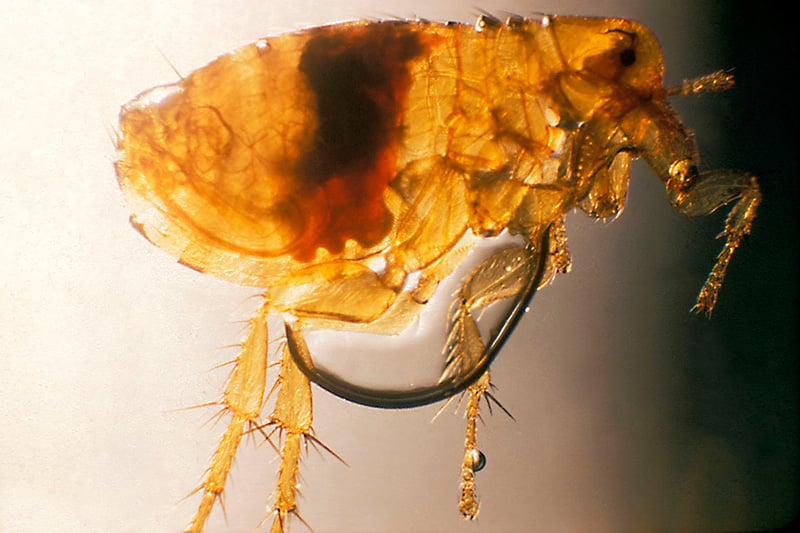
Rat fleas are well known for their connection with plague and its devastating historical outbreaks. Some rat-associated fleas transmit Yersinia pestis, the bacterium that causes the disease. But that history doesn’t mean every rat flea is infected, or that the risk today is the same wherever you live.
Let’s look at two examples: the northern rat flea and the Oriental rat flea. They aren’t the only fleas found on rodents. The northern rat flea, Nosopsyllus fasciatus, is associated with animals including rats and mice and occurs in North America and Europe. The Oriental rat flea, Xenopsylla cheopis, is a well-established plague vector.
What does a rat flea look like?
The Oriental rat flea, Xenopsylla cheopis, is about 1.5–4 mm long, with a body flattened from side to side. Like other fleas it is wingless and has six legs. Under magnification it lacks both the genal and pronotal combs—the rows of spines used in flea identification. In females, a dark sperm-storage organ may be visible inside the body. These are specimen features, not features you can infer from a bite.
A small jumping insect found near rodents is not automatically this species. Distinguishing it from the northern rat flea or other fleas requires a suitable specimen and specialist examination. Photograph or safely contain a loose insect without handling a sick or dead animal; ask a pest or public-health professional how to proceed.
Rat flea life cycle
Both Xenopsylla cheopis and Nosopsyllus fasciatus begin life as small white eggs, typically found around animal bedding and rat dwellings. The larvae that hatch from the eggs are small, pale and wormlike. They don’t drink blood like the adult Xenopsylla cheopis or Nosopsyllus fasciatus, rather they survive on flea droppings, animal hair etc. This is followed by the pupa stage. After pupal development, adults emerge from the cocoons, capable of drinking blood from animals and humans.
Plague risk from rodent fleas in the United States

In the US, plague cases have mainly occurred in rural parts of the western United States, including grassland and the scrub woodland regions in states such as Arizona, Colorado, New Mexico and Utah. Current local public-health information matters more than assuming every rodent habitat carries the same risk. Plague pathogen is transmitted to humans in the following ways:
- The infected rat fleas search for other sources of food when host rats are few in numbers. Humans and pets in the vicinity of infected rats or dead mice are more likely to get bitten by infected rat fleas.
- Pets that roam outdoors can encounter infected fleas on rodents or around their nests and bring fleas into the home. Exposure to infected rat fleas can give rise to primary bubonic plague or septicemic plague.
- Coming in direct contact with fluids of infected animals (especially in case of hunters or butchers) without following proper meat handling precautions is another way of acquiring plague.
- Cats can become infected through relevant flea or animal exposure. An animal with pneumonic plague can spread infectious respiratory droplets; this is different from assuming every flea-infested cat is contagious. Seek veterinary care promptly for illness after relevant exposure and tell the clinic about the circumstances.
Symptoms and treatment of rat flea bites

An itchy bite alone doesn’t tell you someone has plague, and swollen glands don’t inevitably follow every rat-flea bite. With a relevant exposure, bubonic plague can cause fever, chills, weakness and painful swollen lymph nodes. Septicemic and pneumonic plague can cause different patterns of illness.
If you become ill after a plausible exposure to infected fleas or animals, get medical attention immediately. Explain where you were and any animal contact. Don’t wait for every symptom in a textbook or try to work it out from a bite photograph. Medical and public-health professionals can arrange the testing and treatment you need, and prompt treatment matters.
Isolation precautions depend on the form of disease and professional assessment. Pneumonic plague can spread through respiratory droplets, while an uncomplicated flea bite isn’t itself evidence of a contagious respiratory illness.
Preventing rat fleas

Contact local public-health and pest professionals before disturbing nests or killing rodents when plague is suspected or rodents are dying unusually. In a plague outbreak, flea control must precede lethal rodent control: fleas can leave dead hosts and seek people or other animals. Keep people and pets away while a coordinated plan is arranged.
For routine prevention, reduce food, shelter and access and protect pets:
- It’s essential to reduce rodent and rat dwellings. For this, you must remove garbage, clutter, wood piles and other possible rat food sources from around the home. Residential areas, office buildings, schools and day care centers should be made rodent proof.
- It’s important to wear gloves when treating or skinning small animals, squirrels, etc. All meat handling precautions must be followed by hunters and butchers in order to prevent diseases through infected fluid transmission.
- If you’re heading outdoors where flea exposure is a possibility, check current public-health advice and follow your repellent’s label. Use an appropriate EPA-registered repellent for people. Permethrin products for clothing and gear aren’t skin repellents, and human repellents aren’t interchangeable with pet treatments. Don’t put a human DEET product on a pet or use a dog-only permethrin treatment on a cat. Ask your vet how to protect your animals.
- It’s important to keep rat fleas off the pets. Flea infected pets must be promptly treated with vet approved products.
- Pets that are free to roam outdoors are more likely to come in contact with infected rat fleas. At the first sign of sickness in such animals, it’s important to seek medical help immediately. CDC specifically advises against allowing dogs or cats that roam freely in plague-endemic areas to sleep on your bed. Preventing roaming and maintaining suitable flea control reduce opportunities for exposure.
Sources
- WHO: plague outbreak control and treatment sequence
- CDC DPDx: Fleas
- University of Minnesota Extension: Fleas
- CDC: Getting rid of fleas
- FDA: Safe use of flea and tick products in pets
- CDC: How plague spreads
- CDC: Plague symptoms
- CDC: Plague prevention

