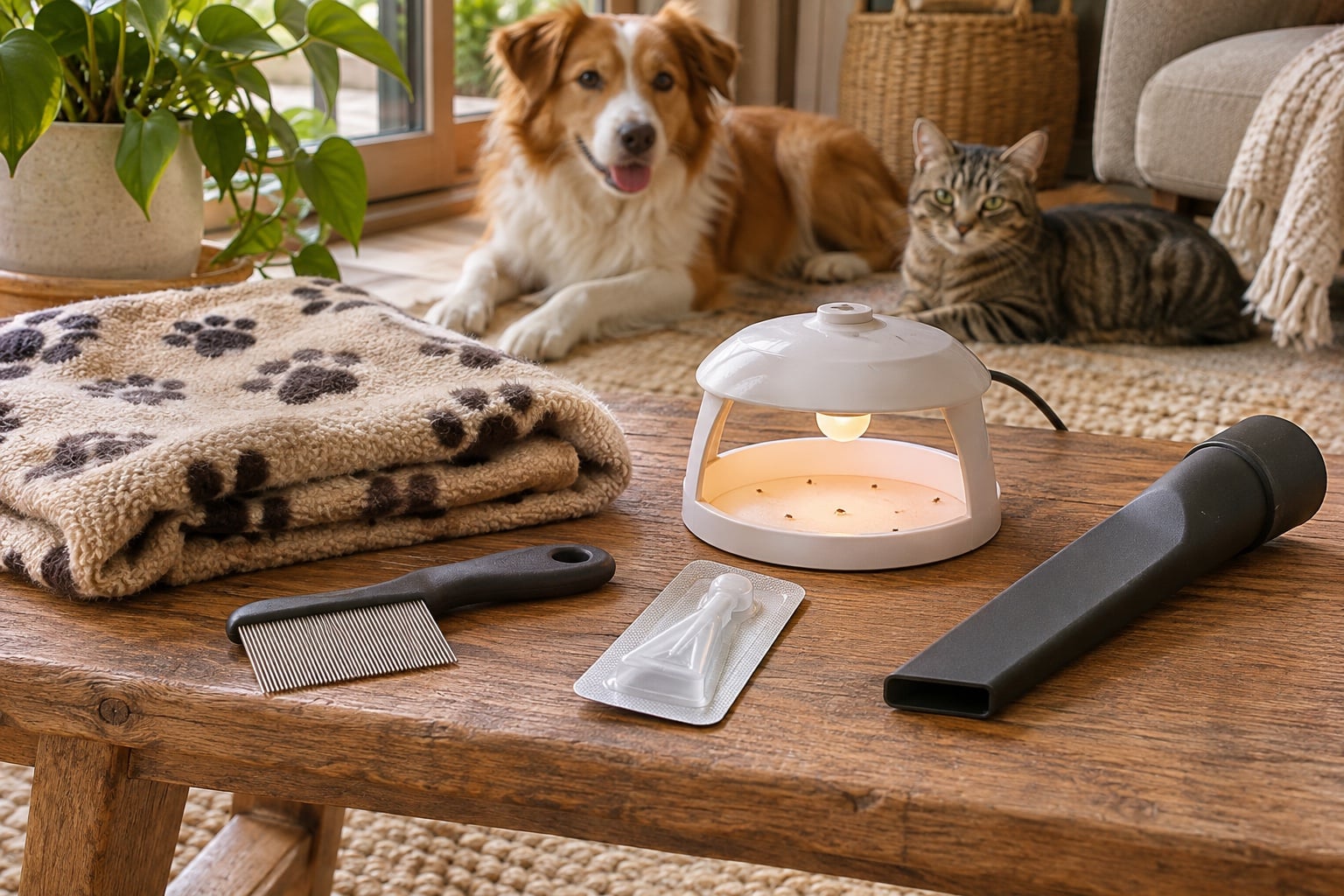
With so many flea remedies to choose from, it’s easy to wonder what you actually need. I’ve dealt with persistent fleas myself, and I put this guide together to make those choices less confusing. Below, I’ll explain how the main types work, their advantages and limits, and where they fit when you’re treating your pets, the house or checking your progress.
No one type does every job. The ten sections below cover pet and household options, with links to fuller selection and use guides. Start with the part of the problem you’re trying to solve, then check the exact product instead of choosing by a familiar name alone.
For a side-by-side comparison of named pet products, see my dog and cat flea control product charts, checked November 16, 2026. You’ll find ingredients, the flea stages and other pests covered, treatment intervals, age and size limits, and notes on water exposure. You can also follow the Amazon links to compare listings; I’ve pointed out older formulations so you can tell them apart.
Affiliate disclosure: Some linked product guides contain affiliate links. As an Amazon Associate I earn from qualifying purchases.
If you need help to stop flea bites from itching, see the bite-care guide and ask a pharmacist which treatment is suitable.
Effective flea remedies for your pets

1. Flea drops
First and foremost are flea drops, also called spot-on or topical treatments. These are the products I used on my dogs when I first wrote this guide. They can be convenient for prevention, but take a look at the ingredients and coverage: different drops affect different flea stages, and only some cover ticks or other parasites too.
Part the coat and apply only at the sites and in the amount specified on the label. Don’t assume every spot-on is monthly, uses the same application point or needs the same drying time. Check bathing, swimming and contact restrictions for that exact formulation. Keep people and other animals from touching or licking a treated area as directed.
Choose for the individual animal’s species, age, weight and health. Never use a dog-only product on a cat, and don’t split a larger animal’s dose yourself.
2. Flea shampoo
Flea shampoo is used when bathing with an appropriate labeled product is part of the plan. Washing may remove some fleas and debris, and a medicated shampoo has its own specific claims. It doesn’t remove every developing flea from the rooms, furniture and bedding around the pet.
Check species and minimum-age restrictions, the application and rinsing instructions, and whether bathing affects another medicine already being used. Don’t turn a dog product into a cat product by diluting it. A cat that dislikes handling, a very young animal or a pet with sore skin may need a different approach and veterinary advice.
3. Flea powder
Flea powder is a name for a type of product, not one set of instructions. Some powders are for particular places around the house; others are labeled for use on animals. A powder for the carpet mustn’t go on your pet just because both packs mention fleas.
Check the intended animal or location, ingredients, application, exposure precautions and cleanup. Dust can be inhaled and animals may ingest material while grooming. Keep it away from faces, food, children and places the label excludes. Avoid improvised mixtures of borax, baking soda or essential oils. If you can’t use a labeled product appropriately, ask a professional about a targeted alternative.
4. Flea collar
A flea collar can provide protection for the uses and period on its label. Medicated collars differ in their ingredients and whether they affect fleas, ticks or other parasites. They aren’t all repellents, and they don’t all have the same replacement schedule.
Check species, age and size limits, fit the collar correctly and watch for irritation or illness. “Organic” or “natural” doesn’t make a collar automatically safer or more effective. Nor is a collar necessarily the right replacement for a spot-on that caused a reaction: the ingredient and the individual animal need to be considered with your veterinarian.
5. Flea pills
Flea pills are medicines you give by mouth. Some kill adult fleas for a short time; others provide ongoing control on a regular schedule. That matters when you’re choosing: dealing with today’s adults isn’t the same as preventing the next ones while fleas continue developing around the house.
Follow the exact medicine’s species, age, weight, dose and feeding instructions. Don’t assume every tablet is given daily or monthly, or that every one must be given with food. Tell your veterinarian about other medicines and parasite products before combining them. Choosing between oral and topical treatment should reflect the animal’s needs and the product’s actual coverage, rather than repeated trial-and-error dosing.
6. Flea comb
A flea comb is a simple, inexpensive tool for checking a dog’s or cat’s coat and removing some adult fleas and flea dirt. Its closely spaced teeth collect material that can be difficult to see by looking at the fur alone.
Untangle the coat first, work gently through small sections and inspect and clean the comb regularly. A light towel under the animal can help you see what falls from the coat. Stop if the skin is painful or the pet becomes distressed. Combing supports identification and comfort; it doesn’t provide lasting protection or remove every egg, larva and pupa from the home. An empty comb doesn’t by itself prove that an infestation has ended.
7. Natural flea control
Natural flea control can mean several quite different things. Combing, cleaning and washing suitable bedding all help without putting a homemade pesticide on your pet. If you’re considering a product sold as natural, still check what’s in it, where it’s meant to be used and the evidence that it works.
Don’t feed garlic to repel fleas or assume that an essential-oil mixture becomes suitable for a pet when diluted. Animals can ingest coat products while grooming. If you want to reduce pesticide use, ask your veterinarian or pest-control professional how to target the actual problem. Replacing appropriate pet treatment with an unproven scent or kitchen recipe can allow the infestation to continue.
Read more about natural flea control.
Flea remedies for your home
8. Flea spray
Flea sprays are sold for different jobs: some are household products, some are for outdoor locations and some have particular labeled animal uses. They aren’t interchangeable. A formulation containing an insect growth regulator can act on developing flea stages; an adult flea treatment has a different role. Check the specific label rather than assuming every spray contains both.
Many years ago, I had a flea problem that seemed to start all over again whenever I thought I’d finished. What I learned was that the adults I could see were only part of it. Eggs, larvae and pupae around the pets’ resting places kept the cycle going after a cleanup. That is why I keep up the cleaning and follow-up treatment even after the first improvement.
Concentrate on confirmed affected areas and permitted surfaces. Follow preparation, food and aquarium protection, ventilation, drying and re-entry instructions. A spray doesn’t replace suitable treatment for every affected pet.
9. Flea bomb
A flea bomb, or total-release fogger, releases pesticide into a space. It may sound like the strongest answer to a bad infestation, but the mist can miss protected places under furniture and elsewhere where fleas develop. It also brings exposure and fire risks, so it isn’t an automatic next step.
University extension guidance favors a coordinated, targeted approach over relying on foggers for flea control. If you’re considering one, read the full label before purchase and review the evacuation, ignition-source and ventilation requirements. Everyone, including pets, must stay out for the specified period. Don’t increase the number of foggers or improvise placement to make treatment “stronger.” A qualified pest-control professional can help when activity persists or the source is unclear.
10. Flea trap
A flea trap with a light and an adhesive insert can capture some adult fleas and help monitor activity in a room. It doesn’t lure every egg, larva or pupa from carpets and furniture, and it won’t do the whole control job by itself.
Follow the manufacturer’s placement, power and insert-replacement instructions, and keep adhesive surfaces out of reach of children and animals. Don’t improvise a mains-powered lamp over an open dish of water. Identify what is caught and use the result alongside pet checks and the rest of the control plan. A few catches, or an empty trap, can’t by itself prove whether the home is clear.
Remember to keep it clean
Lastly, I want to stress the cleaning side of the job. Alongside treating your pets, vacuum affected floors, rugs, furniture and reachable edges daily or every other day during active control, following any cleaning restrictions after treatment. Empty the vacuum or dispose of what it collects as directed, away from your animals’ resting places. Wash suitable blankets and bedding according to their care labels. Keep checking and following the treatment schedule, because more adults may emerge after the first round.
For individual reviews and product-specific comparisons, browse the product guides. Choose a treatment for a defined job and the animal or location involved, then check the exact label before buying.

