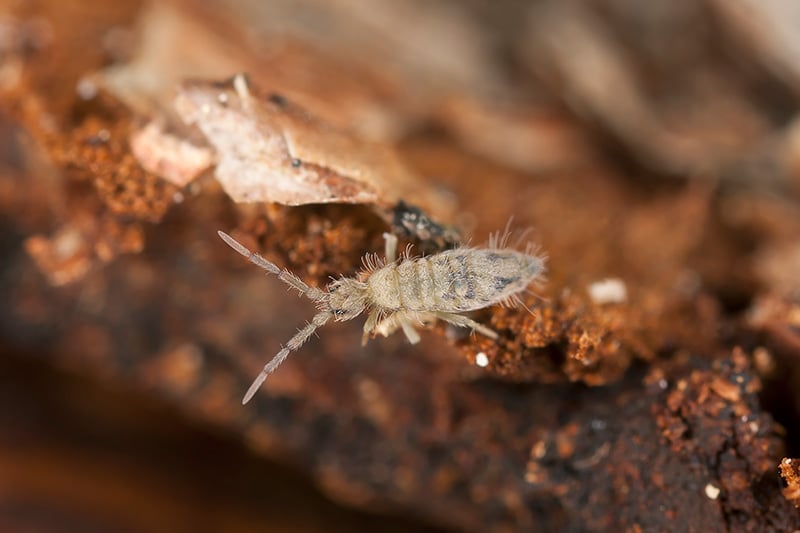
“Snow fleas” are springtails, not the blood-feeding fleas found on pets. Springtails belong to Collembola, a group of small arthropods. Hypogastrura nivicola is one snow-flea species; not every springtail belongs to that genus or appears on snow.
Physical description of springtails
Springtails are very small, commonly around 1/16 to 1/8 inch long. Some are elongated and others more rounded; colors range from pale shades to brown, gray or black, with brightly colored species too. They have antennae and six legs. Mouthparts, eye number and other fine details vary, so one description should not be applied to every member of Collembola.
Springtails get their name owing to a special set of appendages present below the fourth abdominal segment. This appendage, called the furcula, is normally held in place by another special body part (tenaculum) present below the third abdominal segment. On releasing the furcula, springtails are capable of jumping away rapidly. They don’t have wings and can’t fly.
Springtails also have a collophore, a small tube beneath the first abdominal segment that helps take up water. For identification, look at body shape, habitat and behaviour as well as the forked jumping structure. Household fleas have hard bodies flattened from side to side, while springtails tend to look softer and rounder. Just because something jumps doesn’t mean it’s a flea.
Collembola life cycle
Under favorable weather conditions, the Collembola are capable of multiplying very rapidly to the order of thousands per square foot. On drying up of the soil, they need to migrate in search of water.
Springtails prefer moist living conditions found along the pond shores, leaf litters and moist soils. They feed on dead and decaying plant matter, wood, pollen, algae, sap, fungi, mosses etc.
Reproduction and development depend on species and conditions, rather than one timetable for all springtails. Some snow-flea species remain active in cold weather, which is different from being immune to every low temperature. The springtails can work their way up to the surface of the snow, earning a certain springtail species the name ‘snow fleas’.
Young springtails resemble smaller adults and grow through molts. Development time varies with species, temperature, food and moisture. They have several predators. Beetles, ants, centipedes, mites and many other insect-eaters are a threat to snow fleas and other members of the Collembola group.
Are springtails harmful?

Springtails don’t bite humans and are harmless to most animal groups. However, they migrate during hot and dry weather from the lawn into the home, when there is a shortage of moisture and food outdoors.
They may be spotted indoors in areas with water, such as baths, sinks, tubs, around the faucets or near household plants etc.
Springtails help decompose and recycle organic material. Some species can be pests in mushroom-growing facilities or greenhouses, but a household sighting usually calls for a moisture investigation. Persistent dampness and organic material can support a population even after pesticide use.
Treating snow fleas or Hypogastrura nivicola in the home

Confirm the insects are springtails, then check the damp places where you find them. Repairing the moisture problem is central to household control; treating visible insects alone leaves that source in place.
Don’t add water outside to try to lure them away. Instead, look for poor drainage, standing moisture, damp debris and gaps where they’re getting into the building. Fix leaks and condensation and reduce unnecessary dampness around your home. Ventilation or a dehumidifier may help indoors where appropriate. If the damp keeps coming back, find out why rather than only treating the springtails you can see.
You might also find springtails in potting soil, where they usually feed on decaying material or fungi. Plant damage is uncommon, although some species can affect seedlings or particular crops. Adjust watering to suit the plant, improve drainage and remove unnecessary decaying material. Don’t harm your plant by keeping the soil dry for a fixed number of days just to get rid of springtails.
Sources
- University of Michigan: springtail anatomy and life history
- University of Minnesota Extension: Springtails
- University of Minnesota Extension: Fleas

